


Study Tests Anime and Animal Faces for Social Robots
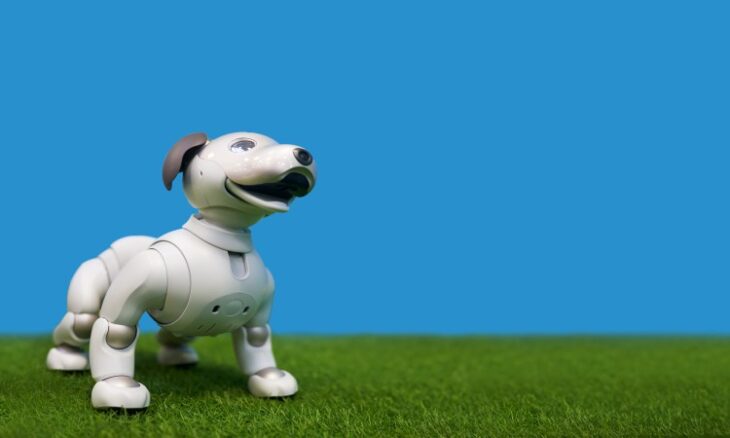
Giving social robots animal-like or anime-style faces and voices could maximise their emotional appeal to users, according to research from the University of Glasgow into the design of zoomorphic social robots.
Social robots can provide companionship and comfort by mimicking human or pet-like behaviours. They form a fast-growing sector of the technology industry, but relatively little academic research has examined how their designs can be optimised to make them as expressive and emotionally engaging as possible.
The Glasgow research addresses that gap by using augmented reality to test different combinations of faces and voices on an existing social robot called Qoobo. The robot has a soft, cushion-like body and a swinging tail, giving it an animal-like physical form.
Social robots can provide companionship in different circumstances. Older people have reported that they can help mitigate feelings of loneliness or social isolation. Zoomorphic robots can also provide some of the companionship associated with real pets for people living in spaces where they cannot keep an animal.
The aesthetic design of zoomorphic social robots has so far largely resulted from educated guesswork, with limited research examining what makes such robots appealing to users. The Glasgow team took a systematic approach by using augmented reality for rapid, side-by-side design testing.
Dr Shaun Macdonald and Josh Yip of the university’s School of Computing Science used the approach to explore how users responded to virtual robots and how effectively they could read the robots’ emotional conditions. They tested dozens of different combinations of faces and voices overlaid on Qoobo, using the system as a rapid prototyping method.
The research builds on Dr Macdonald’s earlier work on social robot design. That work includes the development of a software system called Augmenting Zoomorphic Robotics with Affect, or AZRA. The system can overlay augmented-reality sounds and animations on the bodies of real-world social robots to prototype new appearances and functionalities.
For the latest research, the team first created a mood board of appealing images of animals and robots drawn from real life and popular culture. The images helped the researchers develop five prototype faces for the virtual robots. The designs included animal-like, robot-like, emoji-style and anime-inspired faces, while the fifth consisted simply of eyes.
The researchers also selected five distinct vocalisations for the prototypes. These included recordings of cat noises, human-like vocal sounds, abstract electronic noises, music and samples of animalese. The term refers to the nonsense sounds used by characters in Nintendo’s Animal Crossing game series.
Twenty-four volunteers were given augmented-reality headsets and asked to rank different combinations of faces and voices overlaid on Qoobo. They assessed how clearly each combination expressed an emotion, how much empathy they felt towards the prototype robot and how appropriate the overall combination appeared.
Animal-like faces paired with animal-like vocalisations matched Qoobo’s animal-like body and were well liked by the volunteers. Participants found those combinations more engaging and immersive. Anime-like faces were also ranked highly, despite not being based on real-life animal forms.
The researchers found that anime-like faces provided greater expressive capability than animal faces. The designs allowed the robot to communicate emotions beyond those associated with a normal pet while still retaining a pet-like appearance for the participants in the study.
Faces consistently outperformed sounds when participants assessed how well the prototypes conveyed emotion and created connections. Volunteers found human-like sounds easier to read emotionally, but they liked them less than animal sounds. Participants found animal sounds harder to link to specific emotions.
The study also showed that emotional readability did not closely correspond with design preference. Participants regarded the ability to read a robot’s emotions correctly as important, yet the data showed that readability had little influence on which designs they preferred.
Animalese sounds also ranked highly despite being unintelligible. Some participants felt that the sounds suggested the robot had a greater sense of intelligence than the other types of vocalisation.
Participants’ reactions also depended on whether they owned a real animal pet. Pet owners were more likely to treat the animal-like prototypes as real pets. They were also more likely to treat robot-like faces as machines.
The findings indicated that no single face or voice had universal appeal. Instead, combining the two could substantially affect how well users felt social robots communicated emotions.
The research could inform the design of future generations of zoomorphic social robots and contribute to the development of user-customisable systems. It could also extend the lifespan of existing devices by letting users overlay new faces, voices, and functionality through augmented reality.
The team’s paper, titled ‘Anime, Animal or Animal Crossing? Comparing Aesthetic Styles for Zoomorphic Robot Faces and Sounds using Augmented Reality’, was scheduled for presentation at the ACM International Conference on Mobile Human-Computer Interaction in Swansea, Wales, on Thursday 3 September.
The project was supported by the University of Glasgow’s EPSRC Impact Acceleration Account and the Engineering and Physical Sciences Research Council (EPSRC).