


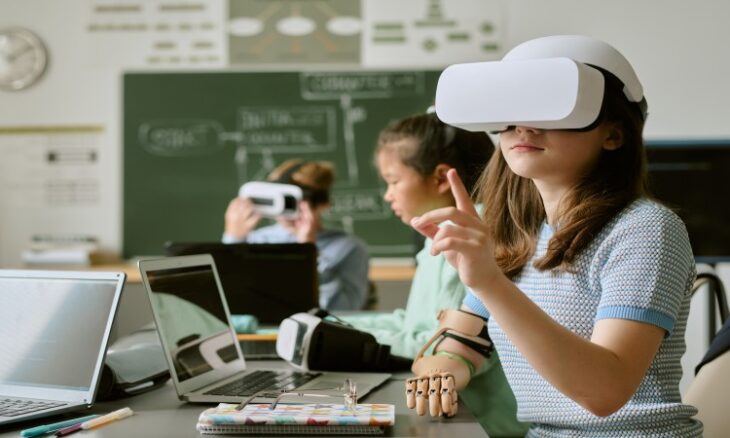
Extended Reality Expands Participatory Learning
Educational institutions are progressively adopting extended reality technologies as digital learning environments become more common among students. Video games, social media platforms, and virtual spaces continue to shape how learners interact with information and develop knowledge.
Extended reality (XR) is being used to build immersive learning experiences across a range of disciplines. The approach unites digital interaction with structured educational objectives. Institutions are using these systems to support practical training, simulations and experiential learning.
The technology includes virtual reality, augmented reality and 360-degree video. Each system is designed to support different forms of learner participation and observation.
Virtual reality uses headsets to place students in digital environments where they can interact with objects and complete simulated tasks. The technology is used for professional skills training, competency assessment, and practice exercises conducted in controlled conditions.
Augmented reality overlays digital information onto the tangible world through mobile devices or wearable systems. The method allows students to examine three-dimensional models, view additional data and interact with visual elements during learning activities.
360-degree video records or simulates complete surrounding environments. The format allows students to observe spaces and situations from multiple angles while remaining within a structured learning setting.
Educational designers are focusing on how these technologies are integrated into teaching frameworks rather than treating the technology itself as the main goal. Learning activities are being built around defined outcomes and hands-on application.
Many hands-on learning systems are designed to reproduce real-world situations. Students are expected to respond to tasks, analyse conditions and make decisions within simulated environments.
Medical training programmes use virtual patients whose symptoms change in response to students’ decisions during diagnosis and treatment exercises. In some cases, developers work with industry specialists or use real case material to improve accuracy.
Business simulations are also being used within immersive environments. Activities may begin with market analysis before progressing to strategy development and performance review. Students move through staged tasks linked to specific learning objectives.
Story frameworks are being included in some immersive activities to provide context for decision-making exercises. Students may be assigned professional roles within digital scenarios and required to complete tasks within operational constraints.
Engineering simulations, for example, may place students in project management roles that involve infrastructure challenges, budgetary pressures, and time constraints. The scenarios are arranged to guide learners through a sequence of challenges.
Environmental science programmes are also using immersive simulations. Students may test sustainability measures and examine the environmental effects of different decisions over time.
Engaged learning systems increasingly rely on direct participation rather than solely on observation. Students are expected to communicate with digital environments, manipulate objects and respond to changing conditions during activities.
Some programmes use branching scenarios in which decisions alter later stages of the exercise. The structure is intended to reinforce practical learning through consequence-based interaction.
Designers are also examining the effect of cognitive demand within immersive environments. Research on working memory suggests that excessive visual detail, sound, or interaction can reduce learning effectiveness.
Institutions developing immersive activities are therefore limiting unnecessary visual effects and background noise in some programmes. Learning materials are being designed to keep focus on the task being completed.
Difficulty levels are commonly increased in stages as students gain experience. Technical training programmes may begin with component identification before progressing to assembly work and fault diagnosis exercises.
Some immersive systems include adaptive functions that adjust task complexity based on student performance during activities.
Accessibility is still a central consideration in the development of hands-on learning resources. Institutions are examining navigation systems, technical reliability and ease of use before wider implementation.
Some programmes include subtitles, modifiable settings and alternative control methods to support different learning needs. Student testing is also being carried out before activities are introduced to larger groups.
Artificial intelligence is increasingly being integrated into digital learning systems and XR environments. The expansion of interactive education technologies persists alongside wider changes in digital education.
Institutions using immersive systems are placing emphasis on structured learning design, practical engagement and competency-based teaching inside virtual and mixed-reality environments.


