


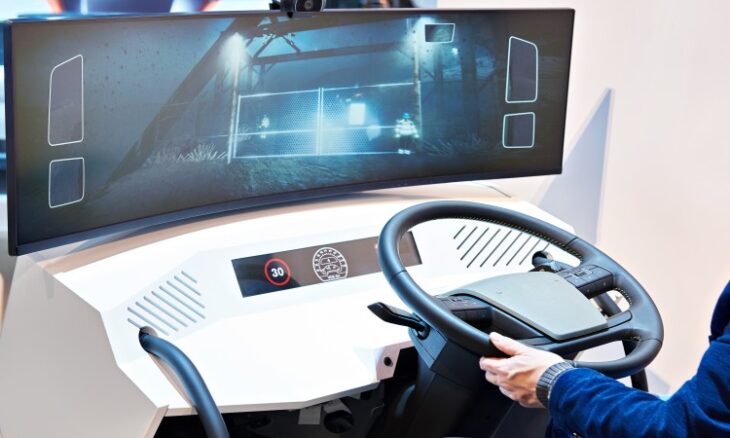
VR Simulator Trains Drivers on BR-277 Highway Escape Ramp
The BR-277 highway’s descent through the Serra do Mar region is especially dangerous for heavy trucks. The steep slopes can make loaded vehicles lose their brakes as they head toward the coast. When this happens, trucks can speed up to over 130 kilometres per hour, making rollovers on sharp curves more likely and putting other drivers at risk. To help prevent these accidents, highway operator EPR Litoral Pioneiro has launched a 4D virtual reality simulator. This mobile training unit shows drivers how to use the emergency escape ramp at kilometre 36,800. The project is part of the Conviver Programme within the Trânsito+ Project, which aims to improve road safety. The simulator is open to everyone and travels to different locations along the operator’s highways.
The virtual reality system looks and feels like a real truck cabin. Participants begin the two-minute session by fastening their seatbelt, starting the engine, and releasing the handbrake. After putting on the headset, they drive through a digital version of the mountain pass. The simulation causes a complete brake failure as the truck nears the escape ramp, and the participant must guide the speeding vehicle safely onto the ramp. The simulator has both a realistic mode and an assisted mode with features like cruise control, anti-lock brakes, and traction control. Users can choose to adjust or turn off physical feedback, such as vibrations from possible crashes or the impact of hitting expanded clay pebbles. The seat can also tilt to mimic a rollover, but this feature can be turned off if the driver prefers. At the end, a digital message reminds users that making safe choices saves lives.
After the simulation, instructors give drivers detailed tips on how to keep their vehicles safe. They remind motorists to check their brakes and keep an eye on tyre condition, wear, and pressure before and during trips. Instructors also warn that overloading a truck makes braking less effective and affects how the vehicle handles on steep roads. Drivers are told to keep their headlights, side markers, and wipers in good shape. The training also stresses the importance of clean, properly adjusted mirrors to avoid blind spots. Instructors go over safe driving habits, like always wearing a seatbelt and following speed limits. Drivers are advised to avoid risky overtaking and to plan their routes so they don’t drive too long without a break. Driving when tired, after drinking alcohol, or while using medications that affect alertness is strongly discouraged.
The Paraná Highway Police say the escape ramp should only be used as a last resort if a driver loses control or has a mechanical failure. Police stress that preventing accidents is most important, which means keeping vehicles in good shape and following traffic laws. The ramp is on the downhill coastal route and was upgraded by the operator in April 2024. It has saved 118 lives in 40 different incidents. Reports show that most drivers who use the ramp do so because their truck’s brakes failed. The ramp is made of reinforced concrete, is 180 metres long and five metres wide inside, and holds 360 tonnes of expanded clay pebbles, about 735 cubic metres. These pebbles are like the ones used in gardening. The ramp can stop a 57-tonne truck going 140 kilometres per hour. There is a 120-metre approach lane with special markings to warn drivers, and vehicles are not allowed to stop there so the ramp stays clear.
The highway operator uses thermal cameras on the mountain pass to watch truck brakes in real time. This helps spot vehicles that might have mechanical problems before there’s an emergency. The operator also runs a colour-coded communication system along the route, giving drivers instant updates about road conditions so they can adjust how they drive.