

Illinois State Upgrades Virtual Reality Therapy Environment
The Neurologic Communication Disorders and Cognitive Wellness (NCDCW) Lab at Illinois State University is upgrading its virtual reality therapy environment through grant-funded improvements. An interprofessional team of faculty members and students has maintained the environment since 2018. The latest developments include a library of virtual reality (VR) assets and updates to clinical training protocols. Two Illinois State University grants awarded in 2026 support the work of Dr Jennine Harvey-Northrop, an associate professor in the Department of Communication Sciences and Disorders (CSD), and Andrea Pizano, a senior interior design student.
Researchers in the CSD department have been working with colleagues in the Department of Technology and the interior design programme to examine how immersive computer simulations can support effective healthcare procedures in actual environments. The project began in 2018 when Harvey-Northrop and Dr Isaac Chang, an associate professor in Technology, explored the potential of using VR to deliver therapy in a simulated home environment.
Harvey-Northrop, a speech-language pathologist with clinical expertise in acquired cognitive-communication disorders, wanted to investigate whether therapy delivered in a virtual domestic setting could help patients transfer skills learnt during treatment to their homes. People recovering from strokes or traumatic brain injuries often need to relearn practical skills that allow them to live safely and independently. The researchers considered whether practising these skills in surroundings similar to those encountered in everyday life could support the transfer of learning from therapy to the home environment, as discussed in Harvey-Northrop et al. (2025).
Chang brought expertise in spatial cognition and the educational applications of technology to the project. His involvement also had a personal connection, as his brother had recently experienced a stroke. He oversaw the design and coding of the virtual environment.
The team selected a kitchen as the initial setting because it plays a role in several everyday activities, including food preparation, dining, and social interaction. Speech-language pathologist Dr Megan Cuellar subsequently joined the project. In 2022, Harvey-Northrop, Chang and Cuellar launched a pilot study at the NCDCW Lab to assess the virtual kitchen environment.
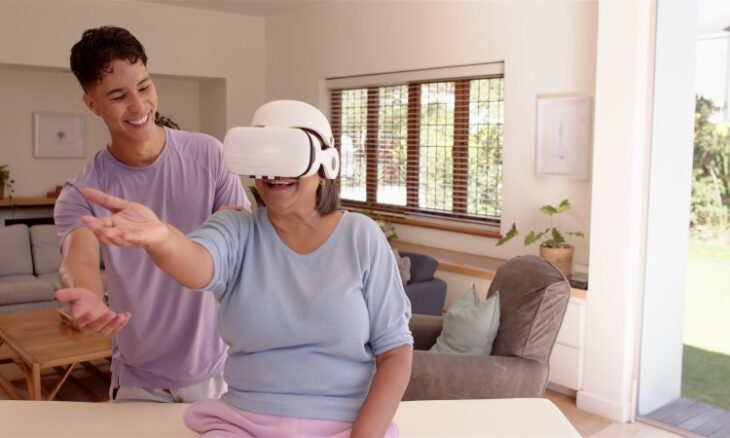
The pilot study ran over one semester and involved graduate student clinicians providing therapy to volunteer research participants through both traditional and virtual methods. During the digital sessions, the clinician and patient remained physically present in the same room. Participants wore VR headsets and responded to therapy prompts while immersed in a simulated kitchen containing interactive items known in the VR industry as assets.
These assets included household appliances, utensils and food items. Participants could perceive, discuss, and manipulate the objects in ways which reflected their everyday use. The interactive setting allowed the researchers to examine how patients engaged with familiar domestic objects during therapy. Participant feedback informed further modifications and expansion of the environment for subsequent research protocols.
The research team has followed an interprofessional working model since the project’s beginning, involving specialists from different academic disciplines as new requirements have emerged. Following the pilot study, the team added Dr Gabriela Fonseca Pereira, an associate professor in interior design at Illinois State University and an expert in home design for safe ageing in place.
Ageing-in-place design principles apply broadly to older adults, including those without cognitive-communication disorders. The same principles can also support independent living for people of any age who have these disorders. Fonseca Pereira and her interior design students contributed their expertise to redesigning the VR environment for clinical trials, which began in spring 2023.
The latest improvements are supported by a University Teaching Grant (UTG) awarded to Harvey-Northrop in March 2026. The funding has been used to create a library of VR assets that students can programme into the therapy environment. The collection is intended to serve as a sustainable resource for students across the three participating disciplines. Interior design students will use the assets to develop ageing-in-place environments; technology students will programme them, and speech-language pathology students will incorporate the virtual environment into person-centred care.
The project also has an educational objective alongside its clinical research purpose. The asset library provides students with opportunities to apply their disciplinary knowledge while working with colleagues from other fields. Its development is intended to support continued improvements to the engaging components of the patient experience, while providing an aid for future student projects and training.
Pizano will work directly with the new asset library. A senior interior design major moving into the accelerated master’s programme, she first became involved in the project through an independent study in spring 2026. During that period, she participated in the interprofessional education training developed by the research team and observed participant sessions to understand design requirements from the CSD perspective.
Her contribution focuses on home design modifications that help people maintain dignity, independence and autonomy within their living spaces for as long as possible. Pizano has already developed a single-storey home design using 3D modelling and design software. She plans to adapt the model for VR functionality and incorporate assets purchased with funding from the University Teaching Grant.
In addition to the University Teaching Grant, Pizano was awarded a 2026 ISU FIREbird research grant to support her continued involvement in the project. The two grants provide financial support for the latest developments while highlighting the project’s guiding principle of cross-professional collaboration. Faculty members and students from CSD, interior design and Technology are working together to integrate new assets into the virtual environment and update clinical training protocols.
The team is preparing these developments for the research protocols scheduled for spring 2027. Participants in those studies will use a virtual therapy environment with more interactive parts than the earlier version. The updated clinical training protocols will also incorporate the changes made to the setting as part of the project’s person-centred care approach.
People interested in participating in the study can contact the NCDCW Lab at ncdwlab@IllinoisState.edu to enquire about joining the waiting list or to obtain further information about the research.