


AI Video Reconstructs Ancient Greek Philosophers
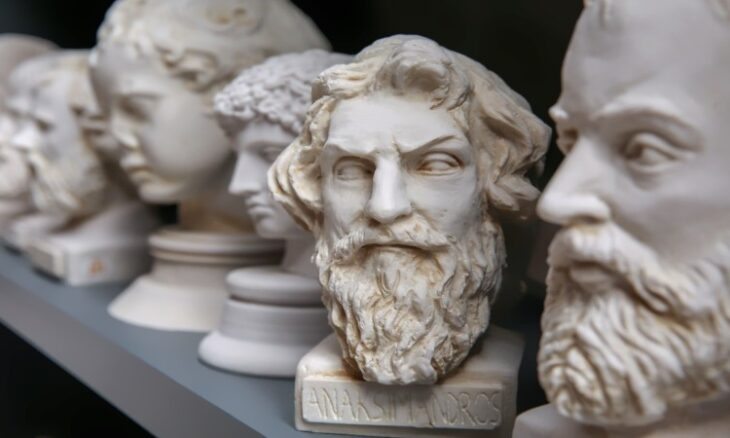
An artificial intelligence-generated video has digitally reconstructed ancient Greek scientists and philosophers, presenting accounts of their lives and contributions using modern technology.
The video was produced by Equator AI, which used artificial intelligence systems to simulate the appearance and voices of historical figures. The production combines AI with elements of virtual reality to depict these individuals recounting their lives and work.
The figures presented include Herodotus, a historian and geographer from Halicarnassus, a Greek city within the Persian Empire. He later became associated with Thurii, in what is now Calabria, Italy. Herodotus is known for writing The Histories, which documents the Greco-Persian Wars. His work is regarded as one of the earliest examples of systematic historical investigation, and he has been referred to as the Father of History, a title attributed by the Roman orator Cicero.
Thales of Miletus is also featured. He was a mathematician, astronomer, statesman and pre-Socratic philosopher from Ionia in Asia Minor. Thales is recognised as one of the earliest philosophers in the Greek tradition and is known for engaging in early forms of scientific reasoning. He has also been referred to as the Father of Science in historical accounts.
The video features Homer, traditionally credited as the author of The Iliad and The Odyssey. These works are regarded as basic texts of ancient Greek literature and have had a lasting influence on literary traditions.
Demosthenes, an Athenian statesman and orator, is also represented. He became known for speeches opposing the expansion of Macedonian power under King Philip II. His orations are considered important records of Athenian political life and provide insight into the culture and politics of Greece during the fourth century BC.
Aristotle appears as a student of Plato who later became Alexander the Great’s tutor. His writings cover a wide range of subjects, including physics, biology, zoology, metaphysics, logic, ethics, aesthetics, poetry, drama, music, rhetoric, psychology, linguistics, economics, politics, meteorology, geology and government.
Socrates is depicted as a philosopher who lived a simple life and rejected material possessions. He was later sentenced to death in connection with his ideas and teachings. His work continued through his students, particularly Plato.
Plato is shown as the founder of the Academy in Athens, a philosophical school where he taught his ideas. He contributed to philosophy through the development of written dialogues and dialectical methods. His work addressed major areas of both abstract and practical philosophy, including the Theory of Forms, which examined the problem of universals.
The video concludes with Chrysippus, a Stoic philosopher of Greco-Phoenician origin. He was born in Soli, Cilicia, and later moved to Athens, where he studied under Cleanthes. After the death of Cleanthes around 230 BC, Chrysippus became the third head of the Stoic school. He was a prolific writer who expanded on the doctrines of Zeno of Citium, the founder of Stoicism, thereby earning recognition as a central figure in the school’s development.
The video presents those historical figures via digital reconstruction, using artificial intelligence to depict their lives and contributions.