


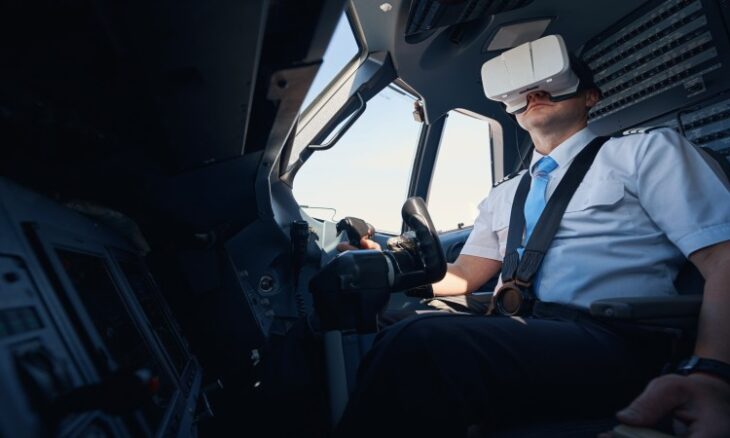
FAA Issues First Framework for Extended Reality Pilot Training
The Federal Aviation Administration (FAA) released new guidance in July covering extended reality training technology. The document establishes the first framework for integrating extended reality, known as XR, into pilot training programmes. Stephanie Fussell, a scientist at Aptima, contributed to the guidance through her work with the FAA, the International Civil Aviation Organisation (ICAO) and industry working groups.
Extended reality encompasses varying levels of immersive simulation technology across both physical and virtual environments. Virtual reality is generally contained within a headset and excludes physical elements outside that setting, presenting virtual imagery without perception of the real world. By contrast, XR incorporates mixed-reality elements, allowing learners to interact with virtual and physical components simultaneously. In aviation training, this can combine computer-generated imagery with a physical flight display, yoke, or buttons, while allowing the trainee to see their own hands during training.
Fussell first encountered the technology now classified as XR while pursuing postgraduate degrees in aviation. During her studies, she came across a paper examining how augmented reality could be applied to pilot training, which prompted her to research the subject in depth. As her research into the benefits and limitations of XR continued, she was invited to join ICAO’s Personal Training and Licensing Panel and the FAA’s Air Carrier Training Aviation Rulemaking Committee. Through those bodies, she helped shape the standards governing how XR technology can be added to flight simulators.
In flight instruction, XR technologies have been examined for their potential to make training more efficient, safer and more accessible. XR systems can support higher learner engagement and motivation, aid longer-term information retention and enable the practice of embodied movements as an advantage over desktop simulators. Increased immersion and interaction also allow trainees to practise and learn about unsafe situations.
Simulators, and especially qualified simulators, are not available at every flight school. Extended reality systems cost considerably less than a Full Flight Simulator or a Flight Training Device, offering a lower-cost option for flight schools without the funds or space for larger systems. Incorporating XR can allow flight training environments to house more qualified simulators without increasing their physical footprint or altering their space.
A few years ago, virtual reality headsets were heavier, slower, and less capable at generating images. Current systems offer a wider field of view, substantially greater processing power, and less reliance on wired connections to a computer.
Some users have experienced simulator sickness, also called cyber sickness, when using XR systems. These episodes typically occur with less sophisticated headsets running at lower frame rates. In recent years, the number of users experiencing simulator sickness has fallen, mainly because of higher frame rates, wider fields of view, and other technical improvements.
Reception among students has been positive so far, although learners remain focused on accumulating flight hours to advance their training. Under the new FAA guidance, XR can form part of a pilot’s flight training progress. The technology can also serve as an additional augmentation, allowing training providers to prioritise full simulator and aircraft use while supporting instruction in the classroom or in one-to-one sessions with an instructor.