


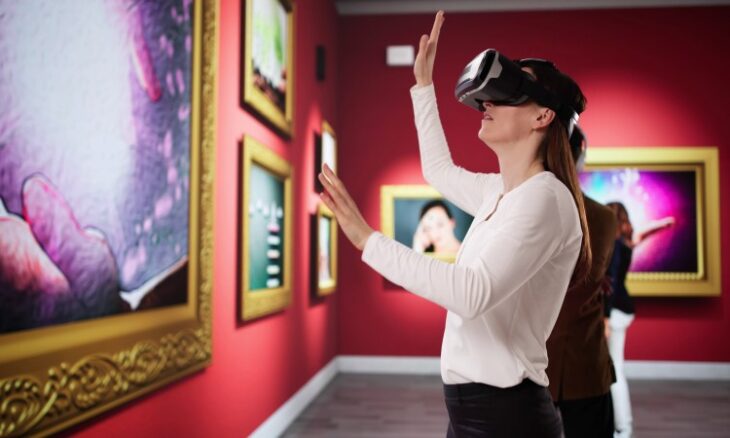
Museum launches AR history tour in Seoul
The Seoul Museum of History introduced a pilot augmented reality exhibition on Tuesday. Titled “Time Travel in Seoul”, the programme operates in the third-floor permanent exhibition hall. Visitors can wear AR glasses to see digital recreations of the city’s historical landmarks and scenes of daily life. The experience uses spatial computing technology that responds to visitor movements in real time, placing three-dimensional content directly over the physical museum environment. As a result, digital imagery aligns with the visitor’s perspective without requiring manual adjustment.
Among the digital recreations is a three-dimensional model of Donuimun Gate. This gate was a notable structure during the Joseon Dynasty, which ruled the Korean peninsula from 1392 to 1910. The reconstruction depicts the gate as it would have appeared in that era. A moving representation of a Gyeongseong streetcar is also visible. This streetcar reflects the city’s early period and the Korean Empire era. Additionally, a rickshaw appears in scenes that depict the Japanese colonial period. The final section of the exhibition shifts to modern Seoul. It incorporates the symbolic “Boy with a Hoop” figure from the 1988 Seoul Olympics. The city’s official guardian character, Haechi, also appears in this section to welcome visitors.
The project draws on multiple sources, combining the historical archives held by the Seoul Museum of History with AR technology supplied by Qualcomm. Qualcomm provided the AR hardware and software for the interactive elements, while Hypercloud, a spatial computing company, provides the immersive content capabilities. The collaboration seeks to establish a model for a smart museum, one that envisions visitors actively experiencing history rather than merely viewing exhibits. The exhibition includes an interactive mission featuring a main character named “Gatssaeng Doryeong”, who guides visitors through the exhibition. Participants collect virtual cards representing important artefacts, including paintings from various periods, sculptures of historical figures, historical documents, clocks, flags that flew over the city and architectural records that detail building designs. Each card offers a different facet of the city’s material culture. After collecting these cards, visitors can select audio guides for context on each era and participate in quizzes related to the corresponding historical periods.
One feature of the exhibition is a camera-based indoor positioning system that allows the digital content to respond automatically to the visitor’s location. Using cameras installed in the exhibition space to track movement, it does not require separate handheld devices or remote controls. The content adjusts seamlessly as the individual moves through the hall. The programme is offered free of charge and will continue through 31 October. Access requires an on-site reservation, which can be made at a rental booth near the third-floor permanent exhibition hall. The booth handles bookings for each available session, and each session accommodates between four and five visitors.