

VR Training Linked to Slower Myopia Progression in Children
A six-month randomised trial found that children who added 15 minutes of nightly virtual reality (VR) digital defocus training to their glasses had less eye growth than children who wore glasses alone. The result provides one of the first concrete clinical signals for VR-based vision training in childhood myopia. This area has previously relied largely on pilot studies and theoretical work.
The study enrolled 120 children aged 6 to 12 from July 2024 in a single-centre, single-anonymised, randomised trial; follow-up ended in September 2025. In total, 116 children, or 96.7 per cent of those enrolled, completed the full six-month period. Of those, 57 were assigned to VR-based digital defocus training plus single-vision spectacles, while 59 remained in the spectacles-only group.
The findings were published as a study report on Figshare in January 2026. The record does not specify whether the study has completed peer review or appeared in a journal. That distinction is relevant when assessing how established the evidence is.
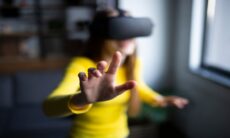
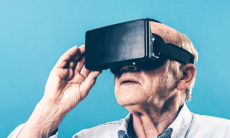
The intervention involved a head-mounted VR device used for 15 minutes each night at home. Before starting the home sessions, each child received one supervised training session in a hospital setting. A parent was present during the home sessions.
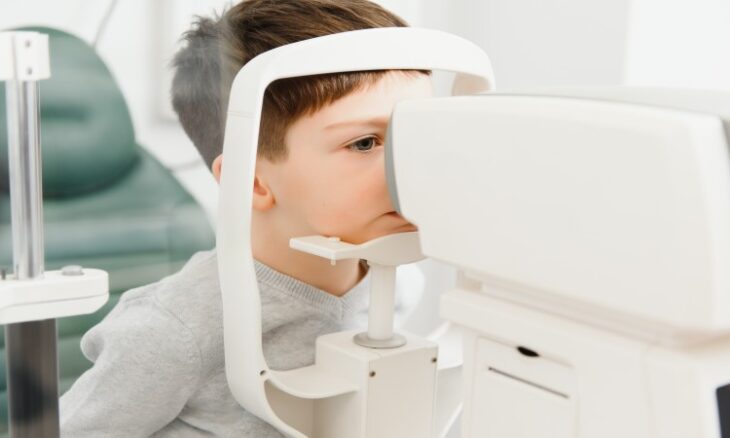
The primary outcome was axial length, the front-to-back measurement of the eyeball. As the eye becomes longer, its optical system falls further out of focus, contributing to worsening myopia. The trial also measured spherical equivalent, which reflects the refractive error recorded in a prescription and the strength of corrective lenses required.
After six months, axial length had increased by 0.147 millimetres in the VR-training group, compared with 0.254 millimetres in the spectacles-only group. The difference of about 0.107 millimetres was reported as statistically significant.
Spherical equivalent changed by -0.230 dioptres in the VR group and by -0.460 dioptres in the control group. This difference was also reported as statistically significant.
Using the study’s reported figures, the 0.107 millimetre difference divided by the 0.254 millimetre growth in the control group amounts to roughly 40 per cent less axial elongation in the VR-training group over six months. That percentage is calculated from the reported measurements and was not presented directly as a percentage in the study report.
No training-related adverse events were reported over the six months. The study authors also described adherence among families as good. They concluded that VR-based digital defocus training may have a role as an adjunct to existing approaches to paediatric myopia control rather than as a replacement for them.
The trial was single-blind. In this type of design, the staff assessing outcomes can be unaware of which group a child has been assigned to, while participants and their families know whether the child is using the VR system. In this trial, there was no practical way for parents or children to remain unaware of the nightly VR sessions.
The researchers also measured several physiological outcomes as secondary findings. Negative relative accommodation and positive relative accommodation, known as NRA and PRA, describe aspects of how the eye adjusts focus at different distances. Accommodative facility, or AF, measures the speed of that adjustment.
NRA, PRA and accommodative facility all improved significantly in the VR-training group. Intraocular pressure fell, visual fatigue eased, and choroidal blood flow increased, with each change reaching statistical significance in the same group.
Those changes occurred alongside the slower increase in axial length. However, the trial did not establish a causal relationship between them. The results showed an association between improved accommodative function and reduced eye elongation, but did not determine which change, if either, drove the other.
The VR approach is part of wider research into technologies that alter how children focus on visual information. A separate trial protocol describes a distant-image screen system called DIST. It converts a nearby image into a virtual image that appears much farther away, thereby reducing the accommodative strain associated with prolonged near work.
The available research does not establish whether DIST operates through the same mechanism as VR-based digital defocus training. The approach demonstrates a broader research effort focused on changing how children’s eyes focus rather than simply reducing screen time.
VR-based training also enters a field in which optical treatments have a considerably larger evidence base. A multicentre real-world clinical practice study followed 1,541 children and teenagers aged 6 to 16 across 8 Aier Eye Hospital Group centres in China. It used propensity-score matching rather than random assignment and examined diversified segmental defocus optimisation (DSDO) lenses, defocus-incorporated multiple segments (DIMS) lenses, and no optical correction.
Among the children with myopia, 654 wore DSDO lenses, and 661 wore DIMS lenses. At six months, axial length increased by 0.07 millimetres in the DSDO group and 0.09 millimetres in the DIMS group. At 12 months, the increases were 0.17 millimetres and 0.19 millimetres, respectively. Both differences were statistically significant in favour of DSDO lenses.
The study reported greater efficacy for DSDO lenses among children aged 10 or younger and among those with lower baseline myopia.
The same research also assessed children without myopia. Those wearing DSDO lenses had an axial length increase of 0.18 millimetres over 12 months, compared with 0.29 millimetres in children without optical correction. The difference was most pronounced during the first six months.
Further lens research is examining a second-generation DIMS lens in a randomised, double-masked trial involving fast-progressing myopic children aged four to 12. The protocol calls for axial length and refraction to be assessed at 12 months. It also includes a planned crossover in which children in the control group move to the experimental lenses in the second year. That crossover is part of the study design and is not a reported finding.
A review from the International Myopia Institute examined interventions across five categories: optical, pharmacological, environmental, coloured light and surgical. Based on randomised controlled trial evidence, it identified multiple effective options in most categories. It also noted that rigorous evidence remains very limited for emerging treatments, including VR-based approaches.
The VR trial has several limitations. It followed children for only six months, so it does not establish whether the slower axial growth would continue, fade, or reverse over the longer period of childhood relevant to myopia control.
The trial also involved 120 children at a single centre. Replication at other sites would be needed to establish whether the result can be reproduced in different groups of children.
Another limitation is the choice of comparator. The VR training was tested against plain single-vision spectacles, not against established optical approaches such as DIMS or DSDO lenses. Its relative effectiveness compared with those treatments therefore remains unknown.
Prevention is another area where results are not yet available. A registered trial protocol plans to enrol 192 pre-myopic children to examine whether DIST-style digital defocus training can delay the onset of myopia. The planned study includes a DIST-only group, a combined DIST-and-lens group and a control group undertaking ordinary near work.
That publication is a protocol rather than a results paper, so it does not provide evidence on whether the intervention prevents myopia.
The International Myopia Institute review has called for more research into the mechanisms behind myopia progression and the treatments that can slow it. The six-month VR trial provides a measured result from an emerging approach. Still, its longer-term effect, its performance versus established lens-based treatments and its potential role in preventing myopia remain unresolved.