


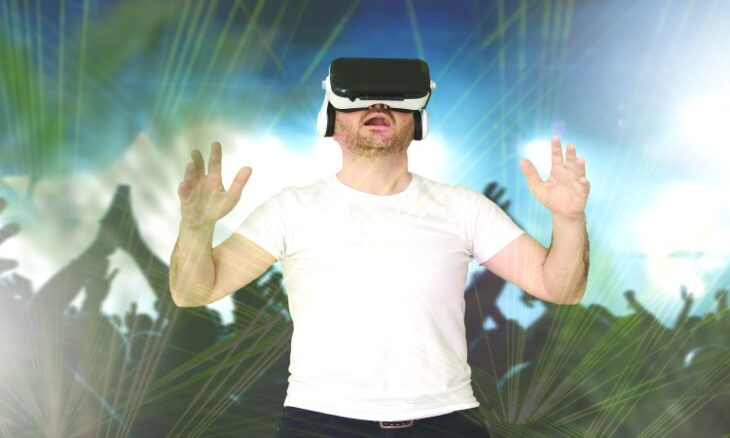
Playing With Fire Brings Yuja Wang Into a VR World
London’s Southbank Centre is hosting an immersive piano production in which audiences can move around a virtual environment while watching a volumetric performance by pianist Yuja Wang. Playing With Fire: An Immersive Odyssey with Yuja Wang is running at the Royal Festival Hall from September 2026 to January 2027 as part of the venue’s 75th anniversary celebrations.
Written and directed by Pierre-Alain Giraud, the production combines recorded volumetric capture with virtual reality, mixed reality, visual art and spatial audio. Vive Arts, a subsidiary of HTC, and immersive entertainment provider Atlas V developed it. The creative team also includes visual designer Gabríela Friðriksdóttir and spatial audio designer Nicolas Becker.
Wang appears in the experience as a pre-recorded volumetric avatar. Her performance was captured at a Steinway Spirio automatic piano using volumetric technology. Audience members wear Vive Focus Vision VR headsets and can move around the performance space rather than remaining in fixed seats. Their position in relation to the piano determines how the experience shifts between mixed reality and virtual reality.
The project began with an initial collaboration between Lightroom, Steinway and Yuja Wang to develop a mixed-reality installation centred on the pianist. Vive Arts had previously worked with Atlas V on other projects and collaborated with the company again for Playing With Fire.
The experience starts with an introduction to the space before visitors put on their headsets. A tutorial explains how they will interact with the virtual environment. Wang’s volumetric avatar then enters the space, sits at the piano and begins Ravel’s Jeux d’eau.
A water scene develops around the performance, with the level rising until the audience becomes submerged in the virtual environment. Visitors can then wander through the space. Audience members can move around together, with some beginning to hold hands as they explore.
Movement also helps connect the physical piano with Wang’s volumetric representation. Visitors can approach the piano closely and see the physical instrument through mixed reality before encountering the volumetric avatar synchronised with it in the virtual environment. The production moves between these two modes as the participant changes position.
Audience members can discover hidden Easter eggs by walking around the room. Its visual and audio design responds to changes in mood, tone and musical character, while animations created by Friðriksdóttir are synchronised with the audio.
Capturing Wang’s performance presented a particular technical challenge for Atlas V. The company already had extensive experience with volumetric capture, but recording a pianist’s rapid finger movements required a different approach. Wang’s fingers can be difficult to see clearly when she performs, making accurate volumetric capture particularly demanding.
The team considered using gloves to track Wang’s finger movements. She did not use them because they could interfere with her performance. Instead, the production team spent two months on research and development to achieve the required timing.
The team also had to account for the audience’s physical movement. Participants wearing headsets can see a blue wall in the virtual environment when they approach a physical barrier. Audience members can also appear as avatars when they are within a certain proximity of one another. People farther away are not continuously visible. Groups attending together can select a team colour for their avatars, making it possible to identify familiar people when they are nearby.
The production follows an earlier run in Paris, where its initial audience largely consisted of people from the traditional classical piano audience. During the first few weeks, most visitors were aged between 45 and 70. The audience later became younger as reviews, word of mouth and appearances on TikTok and Instagram helped the experience reach a different group of visitors.
The production also brings together audiences with different reasons for attending. Some visitors are interested in the music or Wang, while the immersive installation itself draws others. The virtual arrangement also offers a different way to access Wang’s performance, since the physical pianist can be in only one place at a time.
For people already familiar with classical piano concerts, the production offers a different setting for works they may have heard before. During the Paris run, some audience members were accustomed to attending piano concerts but wanted to experience something new. Audience reactions were observed across several performances, including applause after individual pieces, even though Wang was not physically present at the venue.
The music is presented alongside surreal visual imagery rather than being experienced only through the piano. The combination of the performance, virtual environment and visual material gives audiences another way to encounter the works being performed.
The production also explored whether VR could reduce the communal nature of attending a music concert. Playing With Fire is a location-based experience, meaning audiences travel to a physical venue to take part rather than experiencing the production alone at home through a headset.
Participants remain aware of other people in the space. They can see people moving around them, while avatars appear in the virtual environment when other visitors come within a certain proximity. The installation therefore combines physical movement in the venue with the virtual environment displayed through the headsets.
The experience ends by moving the audience back into the physical space. After Chopin’s Waltz in A Minor, visitors remove their VR headsets and spend a period listening to the piano performance without the virtual environment. A beam of light is projected through the large space, and audience members are invited to dance together to the music.
The final sequence brings the audience together physically after spending much of the production moving through its virtual environment. The transition between the virtual and physical elements is part of the installation’s overall structure, with audiences moving between the two spaces before leaving the experience.


