

Czech VR Project Expands First-Aid Training Nationwide
A Czech virtual reality project that places users inside a simulated medical emergency is expanding into schools and public spaces, with organisers aiming to train 1 million people in basic first aid.
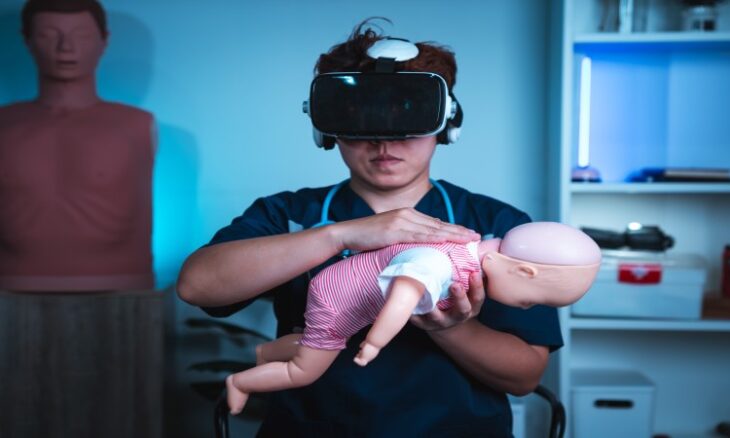
VR Rescue places participants in a virtual emergency involving an unconscious person and takes them through the steps needed to respond. The session lasts about 15 minutes and combines a virtual reality headset with a physical mannequin for cardiopulmonary resuscitation.
The project was developed in cooperation with the Czech Red Cross and medical experts. An artificial intelligence assistant guides participants through the scenario, evaluates their actions and requires them to repeat individual steps when they make mistakes. The system is based on procedures developed with the Czech Red Cross and doctors from University Hospital Plzeň.
Almost 100,000 people have already used the technology. Through the #mocPOmoc initiative, the programme is now expanding to schools, libraries, public offices, and other locations across Czechia. The stated objective is to give members of the public enough practical experience to respond when someone collapses, rather than freeze because they are unsure what to do.
During the exercise, users encounter a simulated unconscious patient and assess the situation before moving to CPR on the physical mannequin. The virtual setting allows them to make mistakes and repeat the relevant steps. Unlike a real emergency, an error during the exercise has no real-world consequence because the virtual patient cannot die.
The system is designed around procedures developed with medical specialists rather than relying solely on an instructor. Its artificial intelligence component checks the participant’s actions and can return them to an earlier step if the required action is not completed correctly.
The project identifies fear of doing something wrong as one of the barriers to members of the public providing first aid. The training allows participants to make and correct errors before facing a real emergency.
Pavel Hrdlička, director of the Plzeň Region Emergency Medical Service, has highlighted the consequences of delayed assistance after cardiac arrest. Each minute without assistance can reduce a person’s chance of survival by 10 to 15 per cent.
Around 35,000 people in Czechia face life-threatening emergencies such as cardiac arrest, stroke or severe bleeding each year, according to figures cited by the #mocPOmoc initiative. The organisers estimate that faster, more effective first aid could save up to 2,000 lives annually.
The project is also moving into the Czech school system. More than 240 schools are due to receive VR Rescue free of charge through support from the Czech Insurers’ Bureau’s Loss Prevention Fund. The Czech Red Cross says nearly 100,000 students across all regions should receive the training within a year.
Plzeň Region has introduced systematic VR first-aid training for nearly 30,000 secondary school students. The programme began in Klatovy, where schools can train up to 700 students a week, including during physical education classes.
Marek Bárdy, the developer of VR Rescue, has identified basic first-aid literacy as a central objective of the project. The programme is intended to extend access beyond traditional first-aid courses and reach adults as well as students.
Self-service VR Rescue stations are planned for libraries, public offices and science centres. Users can activate the training with a QR code. Organisers are also working with companies, sports clubs and community groups to extend the programme beyond formal education and training settings.
The Czech Red Cross intends the VR system to complement conventional first-aid courses rather than replace them. Jana Majrichová, vice-president of the Czech Red Cross, has supported combining traditional courses with virtual reality training as part of efforts to reach more people who may have to respond in an emergency.
The #mocPOmoc initiative has a longer-term target of giving 1 million people the basic confidence and skills needed to respond when someone nearby suffers a life-threatening emergency.
VR Rescue is designed to place users in the position of the first person to arrive at an emergency, before a medical professional is present. In that setting, participants must work through the response themselves using the virtual scenario and physical mannequin. The format differs from relying only on a textbook or instructional video because it places the user inside a simulated emergency and requires them to carry out the response.