


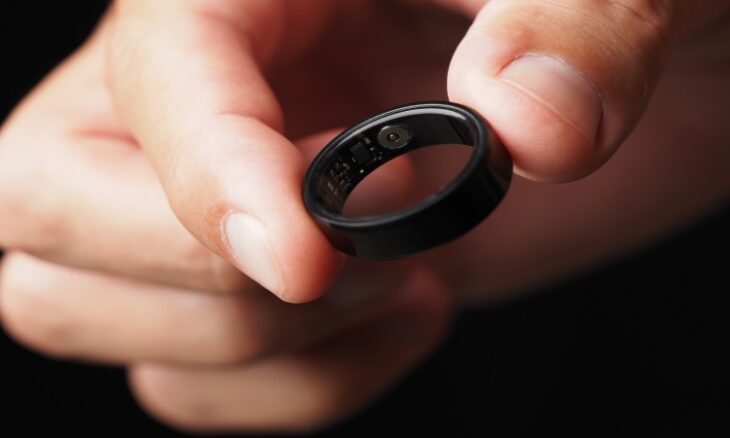
Oura’s Patent Explores Biometric Control for ER
Oura has filed a patent describing tech that lets its smart ring data directly influence what users see and experience in virtual reality. The patent outlines a direct wireless connection between the ring and extended reality devices, letting digital environments respond in real time to biometric signals.
The patent proposes the ring as a continuous sensor for immersive interactions. Monitoring heart rate variability, blood oxygen, and skin temperature, the system gauges a user’s physical state, mood, and exertion.
This data enables virtual environments to adapt to users instantly. For example, if stress increases during meditation, the headset could display calming scenes, such as flowing water or gentle trees, to support relaxation.
The system also supports high-intensity situations. In training or games, the headset could provide audio alerts or haptic feedback to guide performance and focus. Motion sensors can detect excess movement and trigger vibrations to encourage stillness.
The technology can also track users’ long-term reactions to immersive feedback. Analysing data from past days or weeks helps users see trends in health indicators and stress management.
The patent suggests using biometrics as input for gameplay. For instance, heart rate could serve as a control, requiring users to hit targets to advance or unlock new areas.
Current VR headsets track movement but not internal biometric data. This system turns the smart ring into a specialised input for biological and emotional context, deepening immersion.
The patent states that the ring can increase the frequency with which it records biometric data when connected to a headset, providing more immersive data. When not connected, it reduces rates to save battery.
The technology is at the patent application stage and is not a confirmed product. The filing shows the company’s effort to add biometric feedback to virtual and augmented reality systems.