

MIT Develops Ultrasound Wristband for Hand Tracking
Researchers at the Massachusetts Institute of Technology have developed an ultrasound wristband capable of tracking detailed hand movements by monitoring activity inside the wrist. The system uses ultrasound imaging and artificial intelligence to estimate the position of the fingers and palm in real time.
Human hand movement depends on a coordinated system of muscles, tendons, ligaments and joints. Simple daily actions, including writing, gripping objects and using touchscreens, entail continuous movement across many parts of the hand and wrist. Reproducing that level of control in robotics and virtual environments has remained difficult for existing tracking systems.
Current hand-tracking methods rely on cameras, wearable gloves or electrical muscle signals. Camera systems require a direct line of sight and can lose tracking when hands move behind objects or outside the camera’s field of view. Lighting conditions and viewing angles may also affect performance.
Sensor gloves can capture hand movement directly, but they cover the fingers and may affect natural touch and grip. Systems that detect electrical signals from forearm muscles can identify larger gestures, even though smaller changes in finger movement may be harder to capture accurately.
The MIT system was designed to avoid such limitations by observing wrist movement rather than tracking the hand externally. Researchers focused on the tendons and muscles that move during finger activity. Ultrasound imaging was used to capture changes inside the wrist while the wearer performed different gestures.
The wearable device includes an ultrasound sensor roughly the size of a smartwatch. The sensor is connected to compact electronic components and a hydrogel layer that facilitates maintaining contact with the skin. During operation, the wristband continuously records ultrasound images as the hand moves.
Artificial intelligence software analyses ultrasound data and estimates hand positions. The system tracks 22 degrees of freedom across the fingers and palm, enabling it to continuously record multiple hand motions and position shifts.
To train the model, researchers collected ultrasound images alongside recorded hand movements. Volunteers wore the wristband while cameras captured their gestures from several angles. Researchers then matched sections of the ultrasound images with specific finger and palm positions.
This process enabled the artificial intelligence model to identify links between wrist movement and external hand motion. After training, the system could analyse new ultrasound images and estimate the wearer’s gestures in real time.
Eight volunteers with different hand and wrist sizes participated in the study. Participants performed a range of gestures and grasping movements during testing. These included all 26 letters of American Sign Language and the handling of objects such as scissors, pencils, plastic bottles and tennis balls.
According to the study, the wristband tracked both fixed gestures and transitions between movements with high accuracy. Researchers reported that the system could follow continuous motion rather than identifying only separate hand poses.
The device was also tested in demonstrations involving robotics control. In one experiment, a participant used the wristband to wirelessly operate a robotic hand. The robotic hand copied the wearer’s finger movements in real time.
Researchers also demonstrated the robotic hand performing simple tasks, including pressing piano keys and throwing a small basketball into a desktop hoop. The demonstrations demonstrated the system’s ability to convert natural hand movement into machine control.
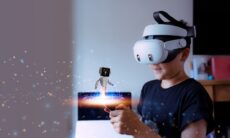
The wristband was additionally tested in virtual environments. Users could manipulate digital objects using hand gestures, including pinching, rotating and moving objects on a screen.
Researchers stated that the technology may support applications in virtual reality and augmented reality systems. Because the wristband does not rely on direct camera visibility, it can continue operating when the hand is partially blocked from view. The design also leaves the fingers uncovered during use.
The research team identified robotics as another possible area of application. Humanoid robots require large amounts of hand-motion data for training and fine motor control. Researchers stated that the wristband could help collect movement data from users with different hand sizes and movement patterns.
The resulting datasets could support the development of robotic systems for tasks demanding controlled hand movement. Researchers noted that this may include environments such as hospitals, laboratories, factories and homes.
The technology may also support assistive systems and prosthetic devices that depend on the correct interpretation of hand movement and user intent.
Researchers stated that the current system remains under development. Subsequent work will focus on reducing the hardware footprint and expanding the training data used by the artificial intelligence model. The team also aims to improve performance among a wider range of users without requiring long individual training sessions.
The research findings were published online in the journal Nature Electronics.