


MediView XR90 Debuts in Florida on Microsoft HoloLens 2
MediView XR said that Cleveland Clinic Weston Hospital had completed the first intraprocedural use of its XR90 holographic surgical navigation system in Florida. The procedure was a percutaneous liver mass biopsy performed by interventional radiologist Dr Kevin Stadtlander on a lesion approximately 10 centimetres deep and located between two branches of the hepatic vein. The biopsy was performed without X-ray guidance.
MediView described the lesion as difficult to access. During the procedure, XR90 fused pre-operative CT images with real-time ultrasound and displayed the combined information as a three-dimensional view aligned with the patient’s anatomy. Cleveland Clinic said the technology allows physicians to combine CT and ultrasound in real time while performing procedures such as biopsies.
Dr Stadtlander said the system allowed the CT and ultrasound information to be viewed together through the headset while he worked on the patient. Cleveland Clinic described the first case as involving a small liver lesion in a difficult-to-reach area. It said the simultaneous use of CT and ultrasound provided better visualisation of the lesion during the biopsy.
MediView CEO and President Mina Fahim said the Florida case reflected the objective the company had set for XR90: combining CT and ultrasound into a single three-dimensional augmented reality view in real time at the point of care. That statement describes MediView’s stated aim for the system rather than an independently established clinical conclusion.
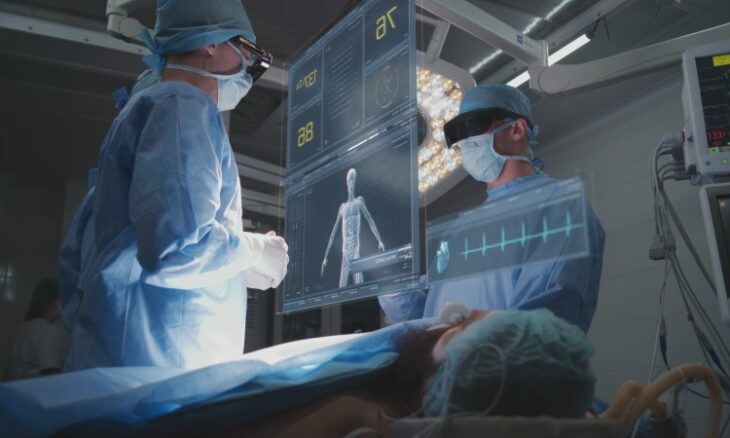
XR90 registers a pre-operative CT scan with live, tracked ultrasound and projects the combined information into the operator’s field of view through a see-through extended reality headset. MediView calls the live ultrasound overlay the Ultrasound Flashlight. The tracked ultrasound probe projects its live image onto the displayed patient anatomy, eliminating the need for the operator to view the ultrasound image on a separate monitor.
The system also includes a Holographic Light Ray that displays the instrument’s tracked path. MediView says the feature is used to support trajectory planning in both in-plane and out-of-plane views. XR90 also provides a configurable heads-up display for procedural information, while anatomical structures can be controlled through voice commands and hand gestures.
The workflow is intended to address how clinicians typically work with separate imaging displays during ultrasound-guided needle procedures. Two-dimensional CT and ultrasound images may be shown on different monitors, requiring the operator to interpret them relative to the patient’s three-dimensional anatomy while moving between the patient and the displays. MediView designed XR90 to place the fused imaging information in the operator’s field of view instead. Cleveland Clinic likewise said the headset allows physicians to maintain their focus on the patient rather than turning to monitors positioned elsewhere in the procedure room.
The system received US Food and Drug Administration 510(k) clearance under K223125. The FDA database lists the device as XR90 (XR90-SYS), with MediView XR, Inc. as the applicant, product code LLZ and a decision date of 13 July 2023. MediView announced the clearance on 20 July 2023.
The FDA-cleared indication states that XR90 is intended for adjunctive use in minimally invasive ultrasound- and CT-guided needle-based procedures involving soft tissue and bone. The system is described as a medical display workstation for three-dimensional image visualisation and interaction using tracked ultrasound, tracked interventional devices and three-dimensional data derived from CT. In this context, adjunctive use means the system provides visual information and reference alongside the established image-guided procedure rather than replacing the procedure itself or the clinical expertise required to perform it.
The FDA clearance also identifies Microsoft HoloLens 2 as part of the XR90 system. The FDA submission lists the HoloLens 2 head-mounted display as a system component. It states that it is used to display imaging and tracked instrumentation during pre-operative planning and intra-operative procedures.
Microsoft ended production of the HoloLens 2 in 2024. Microsoft has announced a support period through 31 December 2027, including security and software regression updates for the device.
MediView’s current XR90 product page describes the display as a see-through headset but does not identify a manufacturer. The company has also not publicly announced a successor HoloLens platform for XR90. The current product description continues to present the system in terms of its see-through headset, tracked imaging and three-dimensional anatomical visualisation.
The HoloLens 2 production decision does not, by itself, establish a defect or regulatory problem with XR90. FDA guidance states that a modification to a legally marketed device requires a new 510(k) when the change might significantly affect its safety or effectiveness, and the 510(k) holder makes the initial determination. FDA can review that determination. As a result, the regulatory effect of any future change to the headset platform depends on the nature of the modification and the manufacturer’s regulatory assessment, rather than being something that can be established from a public product listing.
MediView has continued clinical work with XR90 alongside its deployments. In July 2025, the company announced the start of a multicentre study evaluating the system as an adjunct to standard imaging for percutaneous soft-tissue tumour biopsies. The study was designed to assess procedural efficiency, utility and efficacy when XR90 is used with standard-of-care imaging techniques, including ultrasound and CT.