


Arizona Surgeon Performs State’s First AR Shoulder Replacement
OrthoArizona has announced that Dr Shelden Martin has performed the first augmented reality-assisted shoulder replacement surgery in Arizona. The procedure denotes a new stage in the use of advanced technology during shoulder replacement surgery and represents the introduction of augmented reality guidance for this type of operation within the state.
The surgery was carried out using the ARVIS Augmented Reality System developed by Enovis. According to OrthoArizona, the wearable system provides surgeons with real-time, hands-free surgical guidance at the point of care. The technology delivers visual information directly during the operation, allowing the surgeon to work without relying on separate displays or manual controls.
Dr Martin has been involved in the development of shoulder replacement technology for more than a decade. During that time, he has used first-generation systems based on three-dimensional CT scan planning and customised 3D-printed surgical guides. Those guides are produced from CT scan data and have been used to assist with the placement of shoulder replacement implants.
Dr Martin said existing data had demonstrated that combining three-dimensional CT scan planning with 3D-printed guides enabled implants to be positioned with greater accuracy, exactness and uniformity. He also stated that future data would determine whether the technology improves implant survivorship and clinical outcomes.
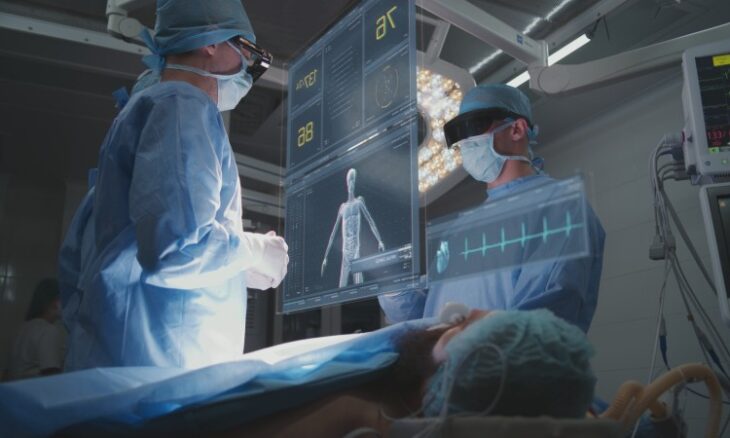
In recent years, Dr Martin has also participated in the advancement of second-generation surgical technologies, including augmented reality-assisted procedures. During the Arizona operation, he wore the ARVIS eyepiece, which was controlled through hands-free gaze and voice commands. The device projected real-time visual guidance directly onto the patient’s anatomy throughout the procedure.
Using the augmented reality system, Dr Martin positioned a guide wire with millimetre-level accuracy. The technology enabled this step without requiring the patient-specific 3D-printed guides used in earlier surgical techniques.
The operation was performed on a patient with degenerative arthritis and rotator cuff pathology. OrthoArizona said that patients undergoing either total shoulder replacement or reverse shoulder replacement are considered suitable candidates for the augmented reality-guided approach, making the technology relevant across a broad range of shoulder replacement procedures as it continues to develop.
Dr Martin described the introduction of augmented reality as an important development in shoulder surgery. He said the use of technology in shoulder replacement is among the fastest-evolving areas within large joint replacement surgery, alongside hip and knee replacement. He also stated that the continued development of the technology is expected to provide greater exactness and more individualised care while improving the pre-operative process compared with first-generation systems.
Shoulder replacement surgery requires highly accurate implant positioning because even small variations can affect stability, function and long-term outcomes. OrthoArizona stated that precision remains a critical factor in achieving successful surgical results.
The organisation also said it is still focused on improving every stage of patient care, from pre-operative planning through to post-operative recovery. It stated that the introduction of augmented reality technology indicates its current efforts to use available surgical tools to improve precision, personalise treatment, and enhance orthopaedic care.
Dr Rajan Bhatt, Chief Executive Officer of OrthoArizona, said every organisational decision is based on upgrading patient care. He stated that augmented reality provides surgeons with levels of precision, accuracy, and reproducibility that were previously unavailable and that the technology can be used across a broad range of suitable patients rather than only in limited cases. He also recognised the work of Dr Martin and the shoulder team in introducing the technology and said the organisation’s investment in new surgical technologies would continue.
Following the first augmented reality-assisted shoulder replacement in Arizona, OrthoArizona and Dr Martin intend to continue assessing how the technology can be incorporated into shoulder replacement surgery and other orthopaedic procedures.
Founded in 1994, OrthoArizona is one of the largest privately held orthopaedic groups in the United States. The organisation provides musculoskeletal care through nearly 30 locations across metropolitan Phoenix. It employs nearly 100 orthopaedic specialists and around 1,500 staff members, offering services including orthopaedics, sports medicine, spine care, interventional pain management, joint replacement, and physical therapy.