


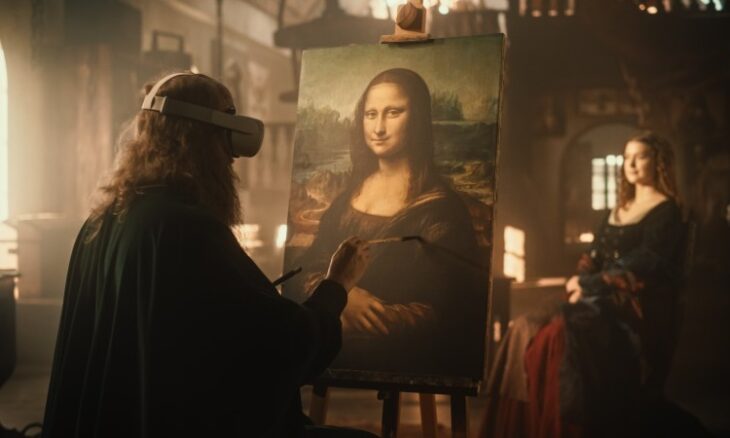
Louvre Introduces AR to Revive Overlooked Artworks
The Kore of Samos, carved in pale marble, has stood at the Louvre in Paris since 1881.
Headless and missing one arm, the sculpture appears today as a fragment of what was once a brightly painted offering dedicated in ancient Greece to the goddess Hera. Visitors see weathered white stone, while the original colours that once covered the figure have long remained invisible.
From this week, visitors can scan a QR code beside the statue to view a digital reconstruction showing how researchers believe it originally appeared. The image restores colour and contextual details through an augmented reality programme developed with Snap Inc’s AR Studio Paris, established in 2021.
The Kore is one of six works included in the initiative. The system overlays research, translation, and reconstruction directly onto objects through smartphones, allowing additional information to be viewed while standing in front of the artwork.
The project focuses on pieces that receive less attention rather than the museum’s most recognised works, such as the Mona Lisa or the Venus de Milo.
Nearly 44 per cent of the Louvre’s visitors are under the age of 26, according to museum figures. The programme has been designed to present information in formats that align with digital viewing habits while maintaining access for all audiences.
The augmented reality layers reveal elements that are no longer visible, provide historical context, and present fragmentary objects in a form closer to their original appearance.
For the Kore of Samos, decades of conservation study have been combined into a reconstruction based on archival material, including information on textiles, pigments, and the object once held by the figure. The digital model was produced in collaboration with curators to ensure that each visual layer corresponds with established research.
The same method has been applied to a bust of the Egyptian pharaoh Akhenaten. Tonal variation that has faded over time has been digitally restored, offering a clearer impression of the sculpture’s original surface.
Other works use the technology in different ways. Interactive overlays help interpret the Code of Hammurabi, a basalt stele inscribed with nearly 280 laws. Hans Holbein the Younger’s Portrait of Anne of Cleves reveals its compositional structure and symbolic elements.
A group of bronze figures known as The Four Captives has been virtually repositioned within its original architectural setting. A Renaissance ceramic basin by Bernard Palissy also includes animated representations of the reptiles and amphibians depicted on its surface.
The programme was developed after curators observed that many visitors focused on well-known masterpieces and passed by other significant objects. Augmented reality allows verified information from multiple sources to be combined and presented within seconds, reducing reliance on extended wall texts or separate materials.
The system has been introduced as a permanent feature within selected galleries, marking a change in how interpretation is delivered inside the museum. The digital content is intended to complement the physical object rather than replace direct viewing.
The technology is designed to reveal details lost over time, including colour, technique, and surface variation, while preserving the scientific integrity of the artworks and the research behind them.
The initiative also reflects the museum’s focus on younger audiences and the role of digital tools in improving access to shared cultural heritage.
The approach has relevance beyond Paris. Louvre Abu Dhabi already incorporates virtual reality within its galleries to support cross-cultural interpretation and contextual storytelling. Discussions are continuing with cultural institutions across the Middle East as interest in digital museum experiences increases.
The wider use of screens in gallery spaces remains the subject of debate. Concerns have been raised about the impact of smartphone use on visitor attention. At the same time, digital interpretation is also seen as a way to make historical material more accessible and easier to understand.
At the Louvre, augmented reality is presented as an additional interpretive layer that allows visitors to quickly grasp complex information while remaining focused on the original object.
As museums in Paris, Abu Dhabi, and other locations adapt to audiences shaped by digital culture, the Louvre’s programme combines contemporary tools with established scholarship. The technology introduces new access methods, while the artworks and their historical significance remain unchanged.


